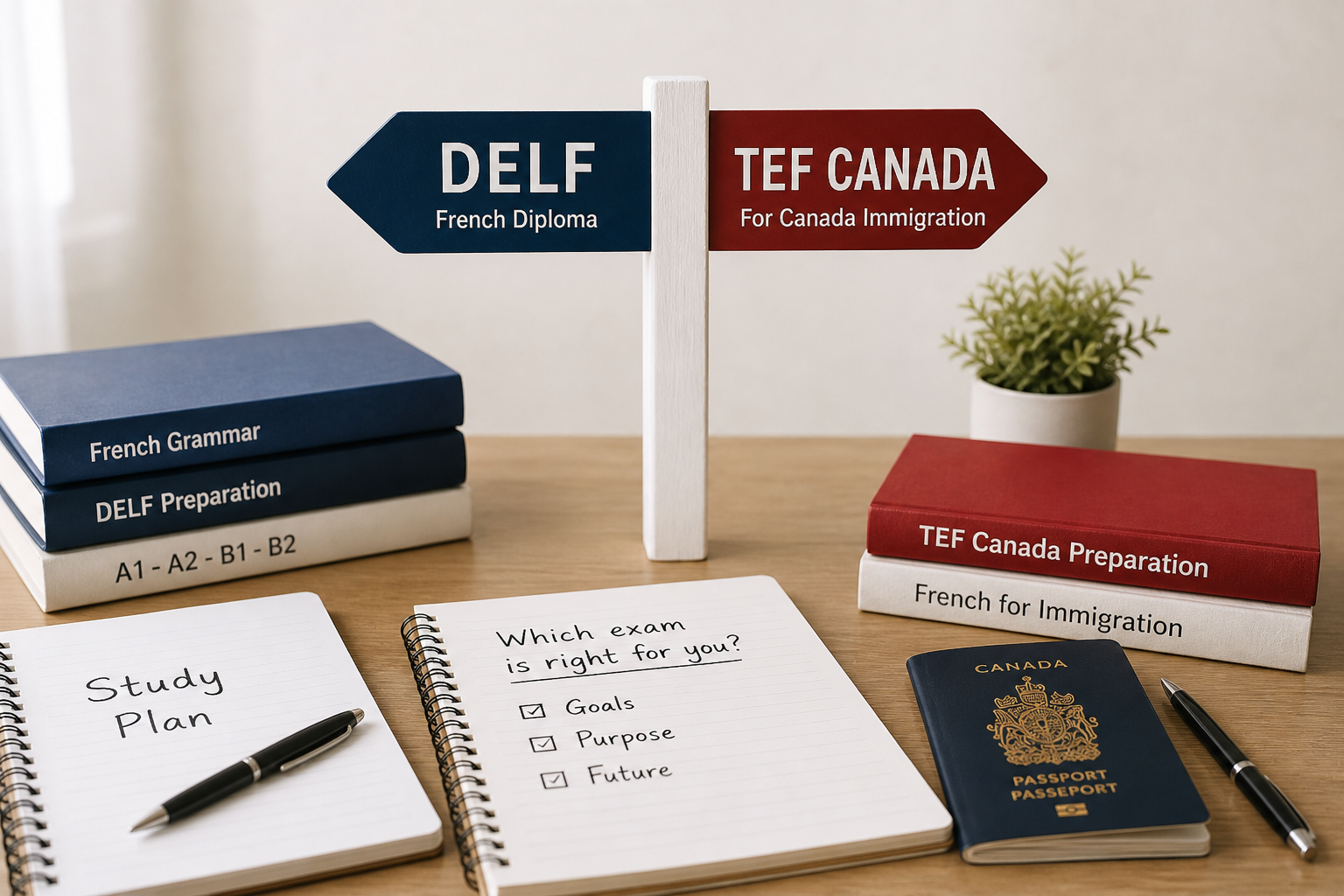
If you are planning to learn French, you may have come across two important exams:
DELF and TEF Canada
Many learners ask:
- What is the difference between DELF and TEF Canada?
- Which exam should I take?
The answer depends entirely on your goal.
Are you learning French for academic certification? Or preparing French for Canadian immigration?
Understanding the difference can help you choose the right path.
What is DELF?
DELF (Diplôme d'Études en Langue Française) is an internationally recognized French language diploma awarded by the French Ministry of Education.
It certifies your French proficiency at specific levels of the CEFR:
Each level is a separate diploma. Once earned, it is valid for life.
📝 DELF Tests Four Skills
Why People Take DELF
Learners choose DELF for:
- Internationally recognized certification
- Study abroad applications
- Academic purposes
- Professional profiles
- Personal language milestones
If your goal is certification of French proficiency, DELF is often the natural choice.
At Art of Language, many students prepare for DELF as part of their structured French progression.
What is TEF Canada?
TEF Canada (Test d'Évaluation de Français) is a French proficiency test recognized for Canadian immigration and citizenship purposes.
Unlike DELF, it is often taken for a specific immigration objective.
📝 It also assesses:
But the purpose is different.
Why People Take TEF Canada
Most candidates take TEF Canada for:
- Express Entry profiles
- Canada PR pathways
- Additional CRS points
- Francophone immigration streams
- Citizenship applications
If your goal is Canada immigration, TEF Canada is usually the exam people explore.
DELF vs TEF Canada — Key Difference
1. 🎯 Purpose
DELF: Primarily a diploma certifying French proficiency.
TEF Canada: Primarily used for immigration-related language assessment.
This is the biggest distinction.
2. 📋 Exam Format
DELF: Level-based diploma exams (A1, A2, B1, B2) — You choose a level and take that exam.
TEF Canada: Score-based proficiency test used to assess language level. Different structure, different purpose.
3. ⏰ Validity
DELF: Valid for life.
TEF Canada: Test validity is time-limited (important for immigration use).
This matters when planning long term.
4. 🎓 Which Skills Are Tested
Both test: Listening, Reading, Writing, and Speaking
But the task types and exam approach differ. Preparation strategies also differ.
So Which One Should You Choose?
Choose DELF
Choose TEF Canada
Can You Prepare for Both?
Yes — and many learners do.
A strong foundation through CEFR levels (A1, A2, B1, B2) often supports preparation for both DELF and TEF Canada.
Many students first build language proficiency and later prepare specifically for TEF Canada.
At Art of Language, learners often begin with general French training and then move toward DELF or TEF preparation depending on their goals.
Which Exam Is Harder?
This is a common question.
The better question is: Which exam is designed for your purpose?
DELF and TEF are different, not "harder vs easier." Success depends on preparation aligned with the exam.
Quick Comparison
| Feature | DELF | TEF Canada |
|---|---|---|
| Purpose | French certification | Canada immigration |
| Levels | A1–B2 diplomas | Score-based test |
| Skills Tested | 4 skills | 4 skills |
| Validity | Lifetime | Limited validity |
| Best For | Study, career, certification | Immigration pathways |
Learn French with Art of Language
Whether you are preparing for DELF or exploring TEF Canada, Art of Language offers structured French courses and exam-oriented guidance from beginner to advanced levels.
Because the right exam starts with the right preparation.
Need help deciding between DELF and TEF Canada? Get in touch with Art of Language to explore the right path for your goals.
Final Thoughts
When comparing DELF vs TEF Canada, the choice is not about which exam is better —
It is about which exam matches your goal.
Confused about which exam to choose?
Get Free Expert GuidanceWe'll help you choose the right path for your goals